Welcome on our platform. Why MUSHROOM MATTER? Because mushrooms play an important role in our lives as well in business. Our goal is to bring the world the very latest mushroom news with the upmost care to support the positioning of our beloved Mushroom.
Picking mushrooms is more than just removing them from the beds. The handling and picking the right mushrooms is vital. Creating space to allow them to grow bigger is not only for yield. A mushroom with enough space has better evaporation and will hold the quality better, longer and will have a better shelf life as well. Handling of mushrooms can affect quality and shelf life.
Are you planning, building or equipping a professional mushroom growing farm? At each of these stages, most investors are looking for answers to the question: whether to look for a general contractor who will take care of the whole investment or whether there is such a scope of this investment, where it’s worth finding an expert in a narrow area.
Why do we look for a general contractor?
The undoubted advantage of choosing a comprehensive contractor who will advise, build and equip the mushroom growing farm with all the necessary elements for the production of mushrooms is saving time and some ease in communication. You don’t need to test a dozen or so subcontractors, but establish good cooperation with only one. The trust that will appear along with the subsequent stages of a properly executed investment will give you peace of mind and space to plan the next steps, such as employment, logistics, sales and marketing. Fewer worries and more time. However, the most important benefit resulting from the choice of a single contractor is usually considered to be the savings obtained by buying everything in one place. After all, it has been known for a long time that by buying a package of services or materials “potentially” we should get lower rates and prices.
On the other hand, probably each of us has heard the saying that if someone declares that he is good at everything, then most often in practice it turns out that some areas of the offer are implemented averagely or even very poorly. Numerous owners of mushroom growing farms will confirm that they encountered or heard about such problems during the implementation of the investment.
In what cases is it worth looking for better solutions?
The key to achieving the high profitability of a thriving mushroom growing farm is to understand what affects the long-term viability of the business and that the devil is in the details. Despite the enormous automation, the largest costs of maintaining leading mushroom growing farms in 2022 are still the employment costs, and even achieving a significant saving on materials for the construction of the facility can only be apparent and will not compensate for the losses sustained in the long term due to the lack of selection of the optimal solutions, which can translate into lower employment costs, higher harvesting efficiency and, consequently, high profitability of the entire mushroom growing farm.
So what is worth paying attention to?
In the beginning, it is worth deepening the knowledge about the equipment for mushroom growing farms that is available on the market. Understanding the principle of operation, the purposefulness of the materials and technologies used will allow us to assess whether and which products available on the market will give us an advantage and facilitate long-term profitability. At the investment planning stage, it’s worth already delving into such products and areas as:
● shelving for mushrooms
● growing nets
● mushroom picking trolleys
● watering systems
● growing tunnel covers (in case of tunnel-like structure)
● lighting
● climate control
Each of the above elements is offered on the market in the form of products based on different quality and methods of execution (materials, technologies, construction, functions, etc.).
Let's use growing nets as the first example. The use of lower-quality materials can most often be noticed after the net becomes narrower after a few months of use and, as a consequence, the compost falls off its edges during transport. In such a case, a frequent and inevitable scenario is a net breakage, which leads to the need to stop loading, collect the substrate and replace the net. In our experience, the weakest nets break down after just a few months, and solid, good-quality products can last 10 or even 15 years.
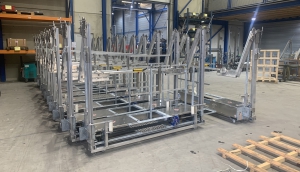
Another example is the mushroom picking trolleys, the design and functionality of which significantly affect the long-term efficiency of harvesting. Machines based on poor quality materials are less durable and require frequent servicing, and when the mushroom picking trolley is not working, the employee's productivity drops dramatically. One of the most important factors affecting the efficiency of the trolley is the time of continuous operation (of the drive of the trolley) between the battery charging processes. Trolleys that run continuously for up to 30 hours or more are a much more cost-effective solution than devices that run for a maximum of 8, 10 or 15 hours. It’s also worth paying attention to the possibility of picking mushrooms from the bottom shelf. This is what most producers declare, but in practice, only some of the devices on the market allow for such picking in an easy way (they have an adequate amount of free access space for the 1st shelf and thus a very low platform placement, which makes the picking easy).

Summary
From our experience, a comprehensive (general) contractor in the mushroom growing industry often focuses on what the customer cares about - the lowest price. Very often, he provides a complete set of solutions, from the construction to the equipment of the mushroom growing farm, and the client accepts them based on trust and apparent savings. However, the cheap construction and equipment of the mushroom growing farm don’t mean long-term profitability for the business.
The profitability of a mushroom growing farm strictly depends on the solutions used in it and if a comprehensive contractor doesn’t offer solutions that are the most profitable (it’s difficult to specialize in every area), the only optimal way is to establish cooperation with a supplier who offers such solutions.
About the author:
GROWTIME is an international manufacturer of mushroom growing farm equipment.
GROWTIME specializes in the production of mushroom picking trolleys, with the focus on increasing the harvesting efficiency thanks to the solutions used in them. See the company's offer at growtime.eu.
In a recent study titled ‘Reactive fungal wearable‘, researchers explore the use of fungi as a potential candidate to produce sustainable textiles that can be used as eco-friendly bio wearables, for instance, the processors in tech wearables like Fitbits could be replaced by incorporating mushroom mycelium.
The joint research venture undertaken by the University of the West of England, Bristol, the U.K. (UWE Bristol) and collaborators from Mogu S.r.l., Italy, Istituto Italiano di Tecnologia, Torino, Italy and the Faculty of Computer Science, Multimedia and Telecommunications of the Universitat Oberta de Catalunya (UOC) has assessed the sensing potential of fungal wearables.
The researchers of the study conducted several laboratory experiments on the electrical response of a hemp fabric captured by oyster fungi by attaching it to computer sensors and stimulating it with attractants and repellents.
Wearable devices require complex and sophisticated circuits that connect to sensors having at least some computing power, thus making them ‘smart’.
Oyster mushroom mycelium, the fibrous mainframe tissues of fungi that populate under the soil and from which mushrooms sprout was able to perceive several external stimuli like light, temperature, and moisture, as well as certain chemicals in the environment, and even electrical signals in a way that imitates the same function for sensors and processors.
To explain this concept further, we use an example of a heart rate monitor, and using the study’s findings, the mushroom’s perceptions of the environment would become the data that gives you the beats-per-minute count on this device.
Please read the full article here.
Source: Green Queen
Lead image – Experimental setup, courtesy of ‘Reactive fungal wearable’ study.
Most women are busy, and taking the time to make healthy food for themselves can be a challenge. Mushrooms are not only great in taste, but also that they hold many health benefits specifically for women.
New research has found mushrooms deliver health benefits for all women, including mums-to-be.
Australian Mushroom Growers Association Dietitian and nationally renowned nutritionist Jane Freeman is encouraging women to boost their mushroom intake to support their overall health.
"New studies have found the addition of mushrooms to a daily diet can be beneficial to women at every stage of life while also providing health and nutrition advantages to their families," Ms Freeman says.
In fact, mushrooms are rich in B-group vitamins and a good source in vitamin D which all women need, but these vitamins are even more essential for women who are pregnant.
Please read the full article here.
Source: AMGA - Australian Mushroom Growers' Assoc
Jacob and Karsten Kirk, twins from Copenhagen, say they have devised a method to reliably grow morel mushrooms in a climate-controlled environment.
The morel mushroom is known as one of the world’s most coveted edible mushrooms. During the last hundred years, it has only with limited success been possible to cultivate black morel mushrooms under controlled, indoor conditions. They are therefore very pleased to announce that they finally, after many years of intensive research at the Royal Veterinary and Agricultural University and the University of Copenhagen, have invented and developed a method for controlled indoor cultivation of black morel mushrooms all-year-round under well defined conditions in climate chambers. The twin brothers are able to produce 4.2 kilos of first-class morels per square metre within a total cultivation period of 22 weeks, corresponding to an annual production of 10 kilos of morels per square metre. The method is so well developed, that a commercial production can be started after an appropriate automation of the cultivation process.
In 1977, when they started studying biology at the University of Copenhagen, they became seriously interested in the biology of edible mushrooms and their possible cultivation. On the basis of various literature studies, they then carried out many experiments with the cultivation of white button mushrooms and oyster mushrooms in particular under private conditions. In the spring of 1978, their lifelong interest in the cultivation of the much more complicated and valuable morels suddenly aroused, as they learned tvery nteresting points.
Please read the full article here.
Source: The Danish Morel Project
Fungi that decompose plant matter may keep ecosystems healthy, especially after drought
The red, orange, and spotted mushrooms that sprout up after it rains are doing more than adding color to the landscape. The fungi that produce them could be keeping the natural world productive and stable, according to a new study. Indeed, they may be critical to the health of Earth’s ecosystems, says Matthias Rillig, a soil ecologist at the Free University Berlin who was not involved with the work.
Please read the full article here.
Author of article: Elizabeth Pennisi
Source: Science
Agro-Projects reports: new opportunities are appearing on the mushroom market of Western Europe as well as in the World.
Agro-Projects, one of the largest general contractors in building mushroom farms and compost yards in Europe, conveys that West European, as well as Central and South European mushroom business, is going to grow significantly during the next 10-20 years. Unlike four-three years ago, when most offer requests that Agro-Projects used to receive, were coming from investors in Eastern Europe - now definitely more than 60% are from investors from Western and Central Europe. New facilities are being built - Agro-Projects has recently finished its construction of three mushroom farms in France, two of them consist of 22 chambers and is currently working on the fourth.
Daniel Dajewski, CEO of Agro-Projects, who has been involved in mushroom industry for almost last 10 years, explains that the movement towards increasing mushroom production in Western Europe is natural for several obvious reasons.
Mushroom becomes “trendy food”
Mushroom is a nutritious product that additionally can be used as meat substitute (The Blend, promoted by Mushroom Council1) and is sustainable (i.e. concept of eating food, produced in responsible to the Earth way, coming to Europe from USA2) so it fits into many nutritional trends of the future. Those trends include: eating healthy products, plant-based diets, paying attention to proteins, antioxidants and other bioactive compounds in food, diet that prevents cancer and dementia, and vitamin D.
Across developed economies of Western Europe, there is a growing popularity of vegetarian and vegan diets, in which mushrooms fit perfectly (e.g. Italian`s percentage of vegetarians during 2019-2020 increased from 7.1% to 8.9%3 ; e.g. in Germany in 2020 the volume of consumed meat substitutes was 25.5 million kg - increase of c. 82% from previous year4).
According to Agro-Projects' customers and partners in Western Europe, nowadays mushroom associations, as well as European farms themselves, are paying more and more attention to making consumers aware of mushroom compatibility trends that are step by step increasing consumption and production.
Local mushrooms displace imported and may cost more
On one hand, in many West European countries consumption of mushrooms is high enough, around 3-4 kg per capita5 , and the demand for them is continuously increasing (e.g. in France6) - so to invest in mushroom farm looks like a good idea. On the other hand, West European countries are used to importing mushrooms from Poland, Netherlands because existing farms cannot satisfy their demand. For example, according to German association of mushroom producers Bund Deutscher Champignon-und Kulturpilzanbauer E.V., in Germany in 2021 domestic mushroom producers where able to produce only 60-65% of the amount of all mushrooms consumed7.
Today the situation is changing dramatically. As one of the investors who is considering building a mushroom farm with Agro-Projects in Germany explains: Germans now want to buy German mushrooms because they are domestic, fresh, moreover buying such mushrooms supports local growers - in fact Germans prefer local mushrooms, even if they cost more. Investors from other West European countries describes the similar situation. No doubts such background opens many opportunities for those who want to set up modern mushroom farm in Western Europe. However, the investor should take into consideration that consumers in these countries have very high-quality requirements for mushrooms, because for years they have been accustomed to buying high quality Polish mushrooms. That's why it's so important to find a partner who can advise and help you design, build, equip, and put into production a truly modern and efficient mushroom farm.
Some mushroom industry experts explain that the movement towards domestic and local products has become stronger during Covid pandemic8, probably as the natural consumers’ desire to feel safe. There is no doubt that mushroom associations and cooperatives, and even government institutions of Western European countries are also investing in promoting the consumption of local mushrooms, as this makes their product more desirable and bought at a higher price (see as the example the project “Mushroom miles9”). In such movement, investors who build mushroom farms in Western Europe, are going to be supported.
Investors are able to have their mushrooms in one year
From Agro-Projects’ many years of experience, we know that the duration of construction of a mushroom farm depends on many factors - first of all, on which contractor you have chosen and what experience he has. If you choose Agro-Projects - the usual 12 chambers farm will take up to 8 months to build10, and mushroom sales will be possible nearly a month and a half after the farm is up and running. In comparison to apples, pears or other fruits - return on investment in the mushroom industry is much faster. Number of Agro-Projects’ clients admit it is the reason why mushroom business is so attractive for them.
Conclusion
In addition, some investors told Agro-Projects that to build a mushroom farm in Europe they can look for some financial back-up from the government or international funds. Since mushroom growing is a type of sustainable production and creates tens of workplaces, some subsides, grants and loans could be received (e.g. in UK11).
Among requires that specialists of Agro-Projects now receive are modernizations of already existing farms in Western Europe. The reason is that domestic suppliers want to compete in quality with imported mushrooms. That is also the topic of the future - number of old West European mushroom farms are going to become modernized. In many countries, where the unemployment level is low and labor cost is on relatively high level, there can be observed a trend of looking for the solutions for more automated production, especially in the area of picking.
West European mushroom markets are growing, new modern farms are going to be built over the next few years and the number of mushrooms produced locally is going to increase. However, this process is not going to be fast and simple. Agro-Projects is one of those partners that transmits knowledge, accumulated over the years and helps to build and equip mushroom farms all over the worlds.
Background information
Polish company Agro-Projects is from one hand one of the largest in Europe companies that designs, builds turnkey and equips mushroom farms and compost yards, from the other hand produces and offers reliable equipment such as filling machines, racks, picking lorries, etc. It has more than 70 completed investments in the world. Argo-Projects has been operating for 7 years in the mushroom sector but the experience among the team and management is much longer.
Please find more information about the company here: https://www.agro-projects.eu/en/


-------------------------------------------------------------------------------------------------------
[1] The Mushroom Council, The Blend. Available at: https://www.mushroomcouncil.com/the-blend/ .
[2] South Mill Champs, Sustainable Mushroom Farm. Available at: https://southmill.com/farm-to-finger/responsibly-grown/ .
[3] Vegolosi.it, Eurispes 2020, aumentano i vegani: mai un dato così alto. Available at: https://www.vegolosi.it/news/eurispes-2020-vegani-vegetariani/ .
[4] Statista, Growth of meat substitute consumption in Germany from 2014 to 2026. Available at: https://www.statista.com/forecasts/1276748/germany-meat-substitute-consumption-growth .
[5] Karol Kania i Synowie, Mushroom Consumption Worldwide – Statistics. Available at: https://kania.net.pl/en/mushroom-consumption-worldwide-statistics/#:~:text=In%20leading%20European%20countries%20consumption,has%20increased%20by%20240%25!
[6] Businesscoot, The mushroom market France. Available at: https://www.businesscoot.com/en/study/the-mushroom-market-france .
[7] Gombaforum, German mushroom production statistics in brief. Available at: https://www.gombaforum.hu/en/2021/gazdasag/nemet-gombaipari-statisztika-roviden/ .
[8] FreshPlaza, Noticeable increase in demand for brown mushrooms. Available at: https://www.freshplaza.com/article/9392667/noticeable-increase-in-demand-for-brown-mushrooms/ .
[9] Mushroom miles. Available at: https://mushroommiles.com/ .
[10] Agro-Projects, Gribowyj Raj - Mushroom Farm. Available at: https://www.agro-projects.eu/projects/gribowyj-raj/.
[11] UK StartUPS, Government Funding For A Mushroom Farming Business. Available at: https://www.ukstartups.org/government-funding-for-a-mushroom-farming-business/ .