 Mushroom Matter
sharing mushroom news with care
Mushroom Matter
sharing mushroom news with care
Menubar













Mushroom Matter
Welcome on our platform. Why MUSHROOM MATTER? Because mushrooms play an important role in our lives as well in business. Our goal is to bring the world the very latest mushroom news with the upmost care to support the positioning of our beloved Mushroom.
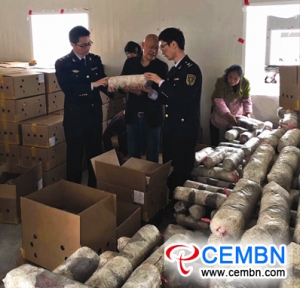
Not long ago, after going through on-site inspection, packaging and sealing, the first batch of Shiitake sticks which weight 95 tons and value 85,000 USD were exported to European union from Chengdu Inspection and Quarantine Bureau, China.
In order to retain the freshness of Shiitake and reduce the risk of transportation, Shiitake sticks which were exported this time are marked as Low-value Products. According to know, the sticks were new Shiitake variety developed by mushroom mavens of Chengdu City, China. After the fruiting, values are doubled and redoubled.
Export of mushroom sticks highlights low risk and remarkable revenues. During the transportation course, fruiting is infeasible by temperature control. After approaching the destination, fresh Shiitakes grow from sticks 7-8 days after adjusting the temperature.
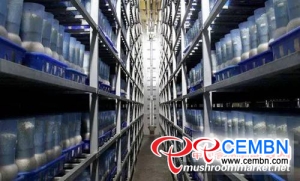
Recently, opening ceremony of mushroom project developed by Jiangsu Ruyiqing Mushroom Biotechnology Co., LTD was ceremoniously held in Donghai County, Lianyungang City, Jiangsu Province of China, which promotes a new constitution.
Founded in 2010, Jiangsu Ruyiqing Mushroom Biotechnology Co., LTD is a modernized agricultural enterprise which mainly engages in R&D, production of Enoki, Shimeji, Seafood mushroom and other rare mushrooms. The company holds 1.1 billion CNY of gross investment, occupies 162,000 square meters of gross area of structure and creates over 2100 jobs. Besides, daily consumption on rice bran, cornstalks and other agricultural wastes attains 1000 tons.
Jiangsu Ruyiqing Mushroom Biotechnology Co., LTD positively introduced complete sets of automatic and advanced equipment from Korea, Japan, Taiwan and other nations and regions. Up to now, a high-tech standardized and industrialized factory that integrates operation of liquid spawn, ecological environment of artificial simulation, intellectualized control and fully-automatic mechanization into one has been established.
On 20th, March, Guizhou Bolete Project primarily invested by Guizhou Hongzhen Mushroom Investment Development Co., LTD launched its construction in Wuligang Village, Longchang Town, Guizhou Province of China.
According to know, the project carries 213 million CNY of gross investment, occupies 22,794 square meters and holds the construction period of 8 months. After its operation, over 2100 poor population could be directly leaded to get jobs and increase earnings.
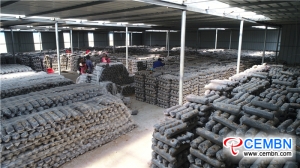
Stick factory which holds the expected annual output of 10 million is put into production
Recently, stick factory which holds 3 million CNY of investment is formally put into production in Sayu Town, Anlong County, Guizhou Province of China. According to know, the factory is the key cooperative production project jointly developed by Guizhou Xinggen Agriculture Technology Co., LTD and Sayu Xialong Development Co., LTD. With the expected annual output of 10 million sticks, the factory could meet the production requirements of 1000 mushroom greenhouses. The formal production has also laid solid foundation for development of mushroom industry in Sayu Town.
As one of main sites for mushroom cultivation within Anlong County, by now, Sayu Town has established 872 mushroom greenhouses that occupy 523.2 mu. Besides, all the accessory equipment have been installed, work of mushroom production is in orderly implementation.
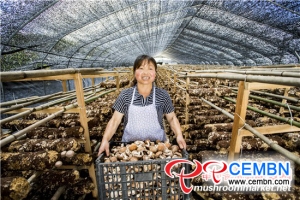
Mushroom industry hints a thriving future
In 2018, Guizhou Province strives to replace low-benefit corn farming with mushroom cultivation. According to calculation, mu output value on corn farming reaches 680 CNY, and mu output on mushroom cultivation is 46 times higher than it.
According to statistics, in 2017, gross capacity on mushroom cultivation obtained 1.056 billion sticks, gross mushroom output hit 569,800 tons and output value achieved 569 million CNY in Guizhou Province, China. By the end of 2019, the anticipated capacity of mushroom cultivation is going to reach 4 billion sticks, mushroom output attains 2.4 million tons and output value comes to 30 billion CNY within Guizhou Province, China.
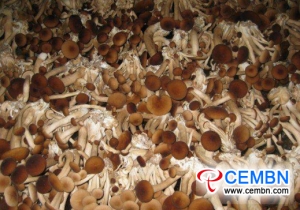
Agrocybe cylindracea cultivation is going wild
Now, in Agrocybe cylindracea base of Benhao Town, Lingshui Li Autonomous County, Hainan Province of China, growers are engaged with Agrocybe cylindracea packaging.
Last year, Benhao Town started to vigorously boost Agrocybe cylindracea industry by development advantage of under-forest economy. Now, the base absorbs 33 mushroom greenhouses, gross output capacity reaches 230,000 bags while daily output on Agrocybe cylindracea attains 500 kg.
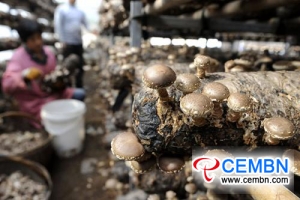
Now, in High-efficient Mushroom Garden of Fengyi Village, Yinjiang Autonomous Region, Guizhou Province of China, Shiitakes vigorously pop heads out of sticks,
“As one of the disabled, heavy works are unbearable to me. In the past, i used to plant corns and potatoes. Along with the quick development of mushroom industry, i decidedly embark on it. By now, i have developed 5000 Shiitake sticks with support of local policy . Within half a year, gross output on fresh Shiitake reached 750 kg and pure profits hit 6000 CNY in my garden,”introduces Mr. Zhongwen Shi, owner of the garden as well as one of poor populations in Fengyi Village.
According to statistics, by the end of 2017, gross mushroom capacity came to 88 million sticks, output value attained 563 million CNY while over 6000 farmers were encouraged to launch into mushroom growing in Yinjiang Autonomous Region, average earnings obtained at least 30,000 CNY per household.
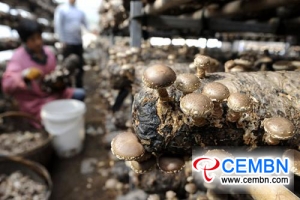
Now, in High-efficient Mushroom Garden of Fengyi Village, Yinjiang Autonomous Region, Guizhou Province of China, Shiitakes vigorously pop heads out of sticks,
“As one of the disabled, heavy works are unbearable to me. In the past, i used to plant corns and potatoes. Along with the quick development of mushroom industry, i decidedly embark on it. By now, i have developed 5000 Shiitake sticks with support of local policy . Within half a year, gross output on fresh Shiitake reached 750 kg and pure profits hit 6000 CNY in my garden,”introduces Mr. Zhongwen Shi, owner of the garden as well as one of poor populations in Fengyi Village.
According to statistics, by the end of 2017, gross mushroom capacity came to 88 million sticks, output value attained 563 million CNY while over 6000 farmers were encouraged to launch into mushroom growing in Yinjiang Autonomous Region, average earnings obtained at least 30,000 CNY per household.





