 Mushroom Matter
sharing mushroom news with care
Mushroom Matter
sharing mushroom news with care
Menubar














Mycelium-based materials are attracting increasing attention as sustainable alternatives to plastic and foam packaging.
By growing mycelium on agricultural by-products, companies can produce lightweight and biodegradable materials suitable for protective packaging and insulation.
Recent developments show growing interest from manufacturers and packaging companies looking to reduce their environmental footprint. As production techniques continue to improve, mycelium materials could become a scalable and circular solution for industries seeking more sustainable packaging options.
Source: Check out the latest trends on Towards Packaging!

Do you wonder where your clothes come from? The material they're made of and how they are produced? Most of us don't, but if we did, we might get a bit uneasy. Now, research is helping the fashion industry take the lead in embracing the circular economy.
If you take an inventory of your closet, chances are you’ll have several garments made at least partly of polyester and nylon. These two low-cost textiles are staples of fast-fashion and currently make up about 60% of clothing and 70% of household textiles.
Polyester and nylon are synthetic fossil fuel-based fibres, meaning they are derived from oil and natural gas. The production of these fibres, their dominant position in the fashion industry, and the fact that they are not biodegradable, means that they have a huge impact on our environment. They also contain harmful microplastics that make their way into every conceivable corner of our land, oceans and waterways.
As a natural fibre, cotton is more easily recycled and requires fewer fossil fuels for its production compared to nylon, for example. However, the cotton industry demands mass land areas for cultivation; worldwide, cotton crops are sprayed with the most chemicals; and, finally, growing cotton requires vast amounts of water.
Where does this leave us? Please read the full article here.
Source: Horizon, the EU Research and Innovation magazine
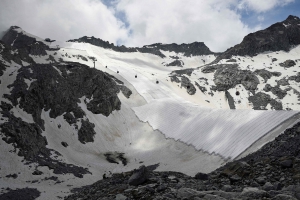
The glacier protection fleece under the brand name of TenCate Toptex® GLS makes it into the Environment section of “Pictures of the year” 2020.
A picture of the spectacular installation of the glacier protection fleece TenCate Toptex® GLS from TenCate Geosynthetics on the Presena glacier in Italy was chosen to be included in Reuters´ renowned “Pictures of the year” 2020.
The most recent installation of the glacier protection fleece under the brand name of TenCate Toptex® GLS from TenCate Geosynthetics, covering over 100,000 square meters of the Presena glacier in Northern Italy, was documented by a photographer from the news agency Reuters. At the end of 2020, one picture of the series was selected to be included in the Environment section of Reuters´ „Pictures of the year 2020“.
Please read the full Press Release here.





