 Mushroom Matter
sharing mushroom news with care
Mushroom Matter
sharing mushroom news with care
Menubar












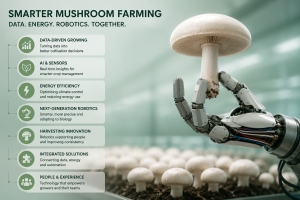
What’s moving the mushroom industry right now?
Technology is becoming smarter and more connected
In our previous edition of Mushroom Matter Industry Insights, we explored how hybrid harvesting, semi-automation and technologies that work with biology are helping growers build more resilient production systems.
The next step in this evolution is not necessarily more automation, but smarter integration.
Across the mushroom industry, data, energy management and robotics are increasingly working together to help growers make better decisions, improve efficiency and optimise production. Rather than operating as separate innovations, these technologies are becoming part of one connected production strategy.
Below, we explore three developments that are shaping the next phase of mushroom cultivation.
Data-driven mushroom farming: turning information into better decisions
Modern mushroom farms generate more data than ever before.
Climate computers, sensors, cameras and monitoring systems continuously collect information about temperature, humidity, CO₂ levels, airflow and crop development. But collecting data is only the beginning.
The real value lies in translating that information into practical decisions.
Increasingly, growers are using data to optimise climate settings, predict crop development, improve harvest planning and identify trends that would otherwise remain unnoticed.
Artificial intelligence is also beginning to play a role, not by replacing experienced growers, but by supporting them. AI can recognise patterns across multiple growing cycles, helping growers respond more quickly and consistently to changing conditions.
The combination of digital insights and human expertise is becoming one of the strongest drivers of production efficiency.
Energy efficiency is becoming part of the growing strategy
Energy remains one of the largest operating costs in mushroom production.
Climate control, ventilation, cooling and heating are all essential for producing a consistent crop, but they also account for a significant share of production expenses.
Rather than treating energy efficiency as a sustainability project alone, many growers now view it as an integral part of crop management.
Optimising climate recipes, recovering heat, improving ventilation strategies and reducing unnecessary energy consumption all contribute to lower operating costs while maintaining crop quality.
The objective is no longer simply to use less energy, but to use energy more intelligently.
The next generation of harvesting robotics
Robotics continues to evolve rapidly, but expectations within the industry are becoming more realistic.
Instead of aiming for fully autonomous harvesting under every condition, today's developments focus on improving precision, flexibility and collaboration with human pickers.
Advances in computer vision, artificial intelligence and gripping technology are enabling harvesting robots to better recognise mushroom maturity, size and position. At the same time, robotics is expanding beyond harvesting into grading, packing and logistics.
These developments allow growers to automate repetitive tasks while maintaining the flexibility needed to deal with biological variability.
Rather than replacing people, the latest generation of robotics is designed to support the entire harvesting process.
Connecting the dots
Although data, energy management and robotics are often discussed separately, their greatest value lies in how they reinforce one another.
Data helps growers understand what is happening inside the growing room.
Energy management ensures the crop develops under the most efficient conditions.
Robotics helps translate those growing conditions into a more consistent and efficient harvesting process.
Together, these developments are creating mushroom farms that are not only more productive, but also more resilient and better prepared for future challenges.
The bigger picture
From our conversations with growers, suppliers and technology companies across the global mushroom industry, one trend is becoming increasingly clear.
Innovation is moving beyond individual technologies. The strongest solutions are those that combine biology, practical experience and digital tools into one integrated approach.
Rather than asking "Which technology should we invest in?", growers are increasingly asking "How do these technologies work together to improve our farm?"
At Mushroom Matter, we believe this shift towards connected thinking will define the next generation of mushroom production.
Looking ahead
In the next edition of Mushroom Matter Industry Insights, we'll once again take a step back from the daily headlines to explore the developments shaping the future of the global mushroom industry.
We'll continue to connect the dots between innovation, cultivation and market developments, bringing together the stories and trends that matter most to growers, suppliers and technology partners.
Published by Mushroom Matter: connecting the global mushroom community through insight, innovation and inspiration.
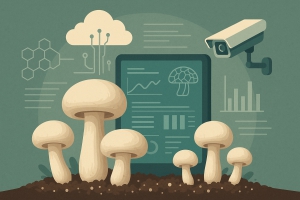
The mushroom industry has always been an example of how biology and ingenuity can coexist. What started centuries ago as a craft based on observation, experience, and intuition is now rapidly evolving into a field where data and digital technology drive every decision. The next generation of mushroom farms is taking shape, intelligent, connected, and remarkably sustainable.
Automation becomes accessible
Until recently, automation was something only large farms could afford. Complex climate control systems, robotic picking solutions, and data-driven monitoring platforms were impressive but often out of reach for smaller growers. That landscape is now changing. As technology becomes more affordable and modular, small and mid-sized farms can adopt automation step by step, from simple environmental sensors to cloud-based farm management systems.
These tools help growers maintain stable growing conditions, reduce labor costs, and minimize waste. More importantly, they allow farmers to focus on the art of cultivation, rather than on manual data collection or repetitive control adjustments.
Smarter growing through data
Every mushroom tells a story of temperature, humidity, substrate composition, and microbial balance. By collecting and interpreting this data, growers can now understand their crops better than ever before. Artificial intelligence (AI) is entering the scene, helping to predict yields, identify anomalies early, and even recommend optimal growing cycles.
Imagine a system that learns the behavior of your farm, adjusting CO₂ levels, light exposure, or irrigation based on previous flushes while alerting you to subtle changes that might affect productivity. That’s not science fiction anymore; it’s the emerging reality of smart mushroom cultivation.
The rise of AI-assisted strain development
While climate control and automation enhance the growing environment, artificial intelligence could soon reshape what we grow. AI-assisted strain selection combines genomic data, performance tracking, and environmental inputs to identify which varieties thrive under specific conditions. This opens the door to developing new strains faster, with higher yields, better shelf life, or specific nutritional or medicinal properties.
For mushroom breeders and spawn producers, this digital layer adds precision to what has long been an art form, bridging traditional mycology with computational biology.
Transparency and traceability through blockchain
Consumers today want to know where their food comes from and mushrooms are no exception. Blockchain technology can bring new levels of transparency to the supply chain. From substrate sourcing to post-harvest logistics, each step could be securely logged, offering proof of sustainability, origin, and quality.
For growers, it’s also a way to build trust with buyers and regulatory bodies, simplifying certification and export documentation. In a world where sustainability is not just a value but a requirement, such traceability systems will likely become standard practice.
Sustainability: the core of innovation
At the heart of all this progress is a shared commitment to sustainability. Automation and digitalization are not replacing the grower, they’re empowering them to produce more efficiently, use fewer resources, and reduce waste. From optimizing substrate recipes to recycling heat and water within facilities, smart systems are helping farms close the loop.
The mushroom sector has always been a pioneer in circular agriculture. Now, by integrating technology, it is showing that environmental responsibility and innovation can grow side by side.
A future rooted in tradition and technology
The message is clear: the future of mushroom farming is intelligent, data-driven, and sustainable. Yet the essence of the craft remains unchanged, understanding living organisms and creating the conditions for them to thrive. By combining centuries-old cultivation wisdom with 21st-century technology, the mushroom industry continues to prove that innovation grows best on a fertile foundation.
Published by Mushroom Matter: connecting the global mushroom community through insight, innovation, and inspiration
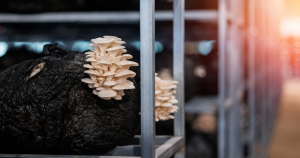
As the mushroom industry continues to evolve, one of the most exciting frontiers is happening beneath the surface, literally. The development of smarter, more sustainable substrates is redefining how mushrooms are cultivated, improving efficiency, productivity, and environmental impact all at once.
The hidden power of the substrate
Every mushroom farmer knows that success begins with the substrate. It’s not just a growing medium, it’s the foundation of the entire production process. Traditionally made from agricultural by-products such as straw, manure, or sawdust, substrates are now being optimized through a combination of science and technology.
Researchers and commercial producers alike are exploring new blends that enhance nutrient availability, moisture retention, and microbial balance. These improvements allow mushrooms to grow faster, stronger, and with more consistent quality across flushes.
Data meets biology
Technology is playing a crucial role in unlocking the full potential of substrate science. Precision monitoring tools, AI-driven analysis, and smart sensors are allowing farmers to better understand what’s happening at the microbial level.
By analyzing temperature profiles, CO₂ emissions, and biological activity in real time, growers can fine-tune conditions to ensure optimal colonization and fruiting. This data-driven approach helps reduce energy costs, minimize contamination, and ultimately increase yields, all while maintaining product quality.
Sustainability from start to finish
The move toward sustainable substrates reflects a broader shift in the mushroom industry toward circularity. Agricultural waste streams, such as coffee grounds, brewery grains, and nut shells, are being repurposed as feedstock for mushroom cultivation.
After harvesting, spent mushroom substrate (SMS) is being given new life as compost, animal feed, or soil enhancer, closing the loop in a truly regenerative production model. This approach not only reduces environmental impact but also creates added value from every stage of the cultivation cycle.
Growing smarter, not harder
As consumer demand for mushrooms and functional fungi continues to rise, the industry’s ability to innovate from the ground up will define its future. The next generation of substrates, designed with precision, sustainability, and circularity in mind, will help growers meet global demand efficiently and responsibly.
In the world of mushrooms, it’s clear that what happens beneath the surface can make all the difference above it.
Published by Mushroom Matter: connecting the global mushroom community through insight, innovation, and inspiration
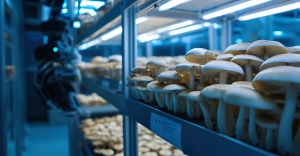
The mushroom industry is entering a digital era. What was once guided solely by intuition, experience, and manual labor is now increasingly supported by sensors, automation, and data analytics. From substrate preparation to harvest, smart farming tools are reshaping how fungi are grown, making production more precise, efficient, and sustainable than ever before.
Precision growing in every layer
Inside modern growing rooms, environmental control systems are evolving into intelligent ecosystems. Sensors monitor temperature, humidity, CO₂ levels, and air circulation in real time. Artificial intelligence (AI) algorithms then adjust these factors automatically, ensuring ideal conditions for each growth phase.
This precision doesn’t just boost yields, it reduces energy consumption and minimizes human error. Instead of reacting to issues after they occur, farmers can anticipate and prevent them, achieving higher consistency and quality across crops.
Data as the new substrate
For decades, mushroom cultivation relied heavily on experience, the grower’s eye and intuition. Those remain invaluable, but now they’re being amplified by data. Smart platforms can collect thousands of data points per day, translating them into actionable insights: when to ventilate, irrigate, or adjust temperature.
Some farms use cloud-based dashboards that visualize performance across different growing rooms or even multiple sites. Others are experimenting with machine learning to recognize growth patterns and predict harvest times with remarkable accuracy.
In short, the farm is learning, and so are the fungi.
Automation lightens the load
Labor shortages have long been a concern in the mushroom sector. Smart technologies are helping to bridge that gap. Automated systems can handle repetitive or heavy tasks such as substrate loading, climate adjustments, or even mushroom picking with robotic precision.
While full automation isn’t feasible for every operation, even partial adoption, for example, using camera-guided monitoring or automated watering, significantly reduces workload while improving consistency. The result: growers can focus more on strategy, quality, and innovation instead of routine maintenance.
A sustainable shift
Beyond efficiency, smart farming supports a more sustainable production model. By fine-tuning environmental parameters, farms use less energy and water. Precise climate control minimizes waste, and optimized substrate management helps reduce contamination rates.
For forward-thinking producers, data also helps demonstrate sustainability performance to customers and investors, turning eco-efficiency into a measurable, marketable advantage.
The human touch remains
Even in the smartest farms, technology doesn’t replace people, it empowers them. Successful growers combine digital insights with hands-on experience and instinct. The art of mushroom cultivation remains rooted in understanding living organisms; technology simply provides new tools to nurture them better.
The road ahead
Smart farming in mushrooms is still in its early stages, but the direction is clear. With each innovation, whether AI-driven control, autonomous harvesters, or cloud-based analytics. the boundary between biology and technology grows thinner.
As these systems become more accessible and affordable, farms of all sizes can benefit from the data revolution. The result? Smarter farms, smarter fungi, and a more resilient, sustainable future for the entire mushroom industry.
Published by Mushroom Matter: connecting the global mushroom community through insight, innovation, and inspiration





