 Mushroom Matter
sharing mushroom news with care
Mushroom Matter
sharing mushroom news with care
Menubar












Trichoderma Green Mold
Causal Organism
Several strains of Trichoderma spp. have been associated with the commercial production of A. bisporus. Some are found as a weed or indicator mold that signals a composting or casing pH problem (Wuest, 1982). In the late 1980s, a new, more pathogenic strain was reported in Ireland and the UK, Trichoderma harzianum (Th2 and Th4). During the 1990s, it spread to Canada and the United States and eventually has been found worldwide in many mushroom-growing operations, and is now classified as Trichoderma aggressivum f. aggressivum (Ta2). This aggressive strain causes the disease known as Trichoderma Green Mold. This pathogenic strain has been found only on mushroom farms. Trichoderma Green Mold spreads throughout mushroom crops and farms through vegetative growth and the production of conidiospores.
Signs and Symptoms
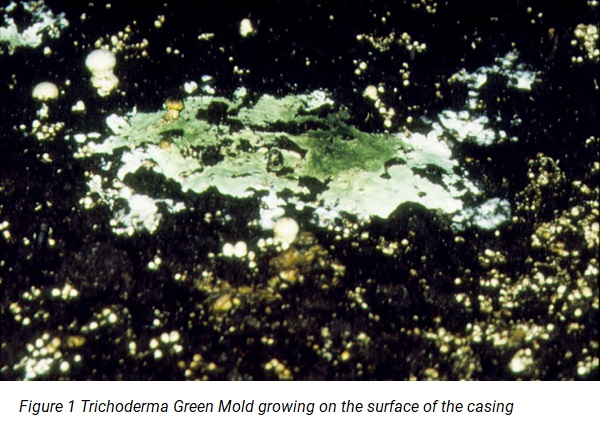
Trichoderma mycelium grows as a grayish color and then changes to white, becoming very dense. Growth during the spawn growing is difficult to discern from the mushroom mycelium. Once it begins to form spores, it turns dark green (Figure 1). Green Mold mycelium grows in the substrate, and the casing aggressively competes with the mushroom mycelium. Often, little to no mushroom mycelium is found in areas heavily colonized with Trichoderma.
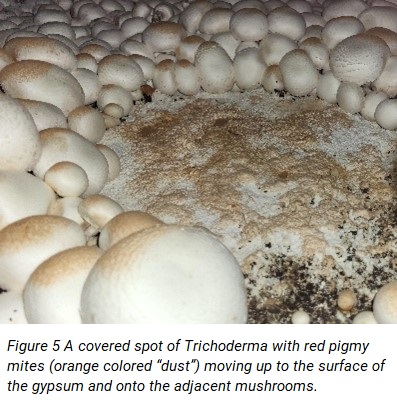
Other Trichoderma species will not cause the disease and only through extensive taxonomic examination or with PCR can they be differentiated from Ta2. However, if Green Mold rapidly grows across the growing surface or is found in the compost below, it is most likely the aggressive Trichoderma Green Mold, Ta2. Another sign of Ta2 infestation is the presence of pygmy mites, though this is not always true, as they feed on other fungal molds that grow in the mushroom substrate.
The mechanism of pathogenesis of Trichoderma Green Mold on mushrooms is not completely known. Some Trichoderma spp. produce toxic metabolites that inhibit the growth of other organisms, and some species can parasitize the mycelium directly. Most evidence so far suggests that Ta2 produces metabolites that inhibit the growth of A. bisporus (Mumpuni, et al., 1998, Krupke, et al., 2003). Electron microscopic observations of the interaction between Green Mold and mushroom mycelium did not show any obvious pathogenicity (Anderson, et al., 2001).
Disease Development
Disease severity or timing of the disease signs and symptoms on a farm may be related to several different circumstances or combinations of these factors. The number of spores and the timing of infection determine when Trichoderma Green Mold will first appear in a crop. An early infestation and/or a high spore load at spawning will result in early signs of the disease, and the severity will most likely be serious. Whereas a later infestation, as before or at casing or a low spore load, will result in the disease developing at or after 1st break and usually with less severity.
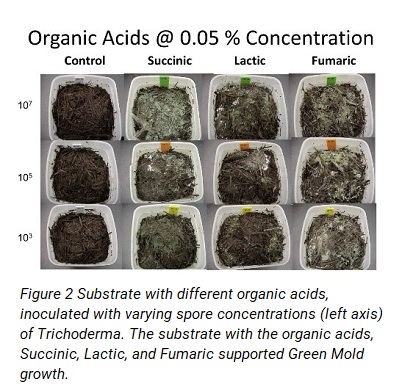
Observations made over the years at farms in Pennsylvania and elsewhere have suggested that certain mushroom composting (Phase I and/or Phase II) conditions were often associated with Trichoderma Green Mold disease development. The occurrence of Trichoderma in farms with high sanitation levels appears to be associated with compost that is not nutritionally selective for the mushroom mycelium. Wet compost, which was poorly aerated during Phase I and/or Phase II, is often associated with increased disease severity or incidence on the farms. Both H. Grogan (personal communication) and Beyer (2008) reported that compost prepared under low-oxygen conditions was more susceptible to disease development. Under these low-oxygen, or anaerobic, conditions, bacteria produce organic acids, which may persist during the substrate preparation process and remain residual after it, when the mycelium of A. bisporus is seeded into the substrate. It has been reported how organic acids encourage the growth of T. aggressivum (Figure 2).
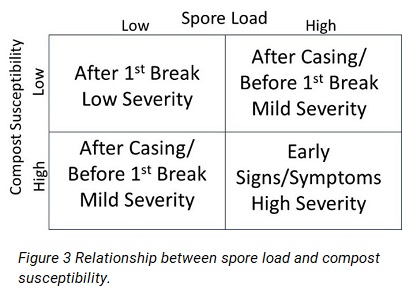
Therefore, the compost's susceptibility and spore load may determine when the disease develops and how severe it may be. Figure 3 shows the relationship between spore load and the susceptibility of compost. So, a well-conditioned substrate with proper moisture may be less susceptible, but with a high spore load at infection, the disease could develop relatively early, with possible mild to high severity. That same scenario may occur with a low spore load infecting a highly susceptible compost.
The spawn grains also play an important role in the initial infection of a crop. The grain carrying the mushroom mycelium appears to be a good source of food or may stimulate Trichoderma spore germination. Protecting the spawn grain with fungicide or using a non-grain spawn reduces the early disease development and severity.
Trichoderma spores introduced onto a fully colonized substrate tend not to cause serious disease. However, bulk spawn run compost (Phase III compost) that is broken up when filling a truck or when placed on farm shelves can be very susceptible to Trichoderma infection. It is assumed that the sugars and carbohydrates within the mushroom mycelium are released when it is broken up, and that these carbohydrates are a readily available source of food for Trichoderma.
Once Trichoderma mycelium begins to grow, it will quickly spread through the compost and casing, and the A. bisporus mycelium will no longer be able to grow there. Trichoderma will spread across the growing surface and continue to sporulate, producing as many as 1,000,000 spores per 1 gram of casing in as little as 24 hours. These spores then serve as inoculum for the next crop or for new rooms.
Control
Disease control depends primarily on reducing or eliminating spores through sanitation and vector control. Trichoderma spores are vectored around the farm in many ways. The spores can adhere to employees, their clothing, and the farm's equipment. Flies, mites, and rodents can also spread the spores. Mites are good secondary vectors because they have specialized structures, called sporangia, that carry and spread spores.
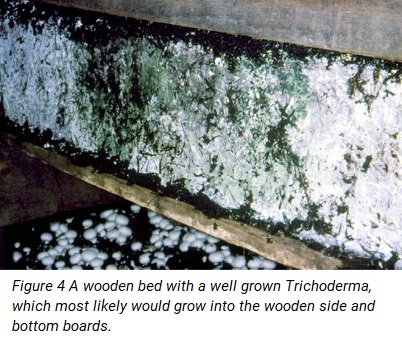
Wooden shelves and trays in crops heavily infested with Trichoderma Green Mold can become impregnated with the Trichoderma mycelium, (Figure 4). If post-crop steaming and Phase II pasteurization are insufficient, that mycelium will be a source of infection in the subsequent crop planted in that room. In addition, Trichoderma spores may survive lower temperatures or shorter post-crop steaming times and infest subsequent crops. A proper Phase II pasteurization with good ammonia concentrations in the air and substrate appears to be effective in killing the spores.
Using a mapping technique to monitor Trichoderma spots after casing through cropping may help determine the source of infection. By monitoring the number and location of the infections, it may be possible to detect a pattern or time of infection. Improperly sanitized spawning equipment may show up if the disease has its highest incidence in the area where the spawning crew starts or in the first trays to be spawned. Mapping the movement of compost from a bulk tunnel into the farm's shelves may also reveal a pattern of infection during tunnel spawning (Obrien et al., 2017). High Trichoderma counts in rooms or areas with the highest fly populations could indicate that spores are entering with flies (Coles et al. 2021). It has also been reported that shelves filled by hand had a higher incidence of Trichoderma in the lower beds than rooms filled with nets (Coles et al., 2024). They related this pattern to employees having to step from the floor into the lowest bed while filling it.
Equipment and personnel from infested crops should be prevented from entering the spawning or casing areas during those operations. Additional steps, such as issuing new uniforms daily to spawning personnel and separating cafeterias and break rooms for employees working in the spawning and casing areas, are effective.
Although Trichoderma spores are not easily airborne, dust particles and flies can carry them, so filtration and air pressure during the spawning and casing operations are critical. Maintaining positive pressure in a spawning area or room would help reduce the risk of contaminants from vectors contaminating a fresh substrate.
To reduce the spread of spores within an infected crop, cover all spots of Trichoderma with either salt, hydrated lime, gypsum, or alcohol. Whatever is used should cover several inches beyond the infected area. Usually, the substrate under the infected area is greater than what is seen on the casing, so extending the covering material beyond what is seen will help prevent new areas from developing from the infected substrate below.
Existing registered chemical fungicides are ineffective in reducing or eliminating actively growing Trichoderma mycelium once it is established in the compost or casing. Control is primarily good composting, complete pasteurization, a complete sanitation program, especially at spawning, and efficient post-crop steaming procedures. If this disease gets out of control, it is better to steam off the crop early to reduce the spore inoculum that could spread to subsequent crops.
References
Anderson, M. G., D. M. Beyer, and P. J. Wuest. 2001. “Yield Comparison of Hybrid Agaricus Mushroom Strains for Resistance to Trichoderma Green Mold.” Plant Disease 85: 731–734.
Beyer, D., K. Paley, J. Kremser, and J. Pecchia. 2008. “Influence of Organic Acids on the Growth and Development of Trichoderma aggressivum, a Pathogen of Agaricus bisporus.” Pages 540–555 in Science and Cultivation of Edible and Medicinal Fungi: Mushroom Science 17, edited by Van Gruening. Pretoria, South Africa: South African Mushroom Farmers Association. Proceedings of the 17th International Congress, Cape Town, South Africa, May 20–24 (CD-ROM).
Coles, Phillip S., Maria Mazin, and Galina Nogin. 2021. “The Association Between Mushroom Sciarid Flies, Cultural Techniques, and Green Mold Disease Incidence on Commercial Mushroom Farms.” Journal of Economic Entomology 114 (2): 555–559. https://doi.org/10.1093/jee/toaa322.
Coles, Phillip S., Milton E. McGiffen Jr., Huaying Xu, and Moises Frutos. 2024. “Compost Filling Methods Affect Green Mold Disease Incidence in Commercial Mushrooms.” Plant Disease 108 (3): 666–670. https://doi.org/10.1094/PDIS-06-23-1101-RE.
Krupke, Oliver Albert, Alan J. Castle, and Danny Lee Rinker. 2003. “The North American Mushroom Competitor, Trichoderma aggressivum f. aggressivum, Produces Antifungal Compounds in Mushroom Compost That Inhibit Mycelial Growth of the Commercial Mushroom Agaricus bisporus.” Mycological Research 107 (12): 1467–1475.
Mumpuni, A., H. S. S. Sharma, and A. E. Brown. 1998. “Effect of Metabolites Produced by Trichoderma harzianum Biotypes and Agaricus bisporus on Their Respective Growth Radii in Culture.” Applied and Environmental Microbiology 64 (12): 5053–5056. https://doi.org/10.1128/AEM.64.12.5053-5056.1998.
O’Brien, M., K. Kavanagh, and H. Grogan. 2017. “Detection of Trichoderma aggressivum in Bulk Phase III Substrate and the Effect of T. aggressivum Inoculum, Supplementation and Substrate-Mixing on Agaricus bisporus Yields.” European Journal of Plant Pathology 147 (1): 199–209. https://doi.org/10.1007/s10658-016-0992-9.
Wuest, Paul J., and Glenn D. Bengtson, eds. 1982. Penn State Handbook for Commercial Mushroom Growers: A Compendium of Scientific and Technical Information Useful to Mushroom Farmers. University Park, PA: The Pennsylvania State University, College of Agricultural Sciences.
https://www.mushroommatter.com/details/itemlist/tag/casing#sigProIdd622a745c1
Compost-casing-mushroom water relationships
The function of casing is to induce fruiting, support mushroom growth, and provide a source of water to the mushroom that compensates for its water lost through evaporation and transpiration. Sometimes, there has been an overemphasis on the influence of the moisture layer in the casing on mushroom yield and quality. A large variation in the compost substrate moisture may have more influence on mushroom yield and fresh mushroom quality. It is not to say that casing moisture does not influence yield or quality, but it may take a larger disparity in moisture to markedly influence the end product.
The mushroom relies on water potential gradients to move water through the mycelium. Water flows from regions of higher water potential to lower water potential, which helps maintain turgor pressure necessary for mycelial tip extension and growth. This same gradient also affects nutrient transport: nutrients, ions, and metabolites often move along with water via bulk flow or are actively transported across membranes, but their distribution is shaped by the underlying water potential differences within the mycelial network and between the fungus and the compost.
In a mycelial network, water potential gradients help the translocation of nutrients—moving them from the compost, the resource-rich region, to actively growing hyphal tips or fruiting bodies. Under dry conditions, the external water potential becomes too low, water movement into the hyphae slows, reducing nutrient uptake and impairing growth. Conversely, favorable water potential promotes efficient uptake and redistribution of resources throughout the mycelium.
Think of thicker rhizomorphs in the casing as the big pipes that move water and nutrients from the compost to the developing mushrooms. To keep mushrooms healthy and productive, this pipe system needs to stay in good working order all through the crop. Just like it’s easier to move water through a fire hose than a garden hose, well-developed rhizomorphs make water delivery more efficient. Keeping the casing wet or moist is what allows these larger “pipes” to form and continue feeding the mushrooms. If the casing dries out during production, most strains will give lower yields and poorer quality mushrooms. In the end, this whole water network relies on the compost as the main source of water for the crop.
Water is constantly moving during the cropping cycle. Mushrooms take up water into their cells, while water is also lost through evaporation and transpiration. Growers replace this loss mainly by watering the casing layer. However, we still know little about exactly how mushroom mycelium absorbs and transports water, or how water moves through rhizomorphs into the mushroom itself.
Some research suggests that water uptake depends on differences in water potential between the mycelium and the compost solution (Kalberer, 1987). As cropping progresses, mushrooms use water from both the compost and casing, while evaporation, transpiration, and respiration continually reduce the water content of the crop. This loss lowers the water potential inside mushroom cells. Because water moves from higher to lower potential, this gradient may allow mushrooms to absorb water with little energy cost. Another idea is that nutrient absorption helps drive water uptake (Holtz, 1971; 1979; Schroeder & Schisler, 1981; Kalberer, 1987). When nutrients are actively absorbed by the mycelium, the osmotic potential inside the cells decreases. Water then follows passively, moving in response to the concentration of nutrients. The developing mushrooms produce the sugar mannitol and therefore have a much higher concentration than the vegetative mycelium (Holtz, 1976). It was suggested that this different concentration of mannitol creates the osmotic and water potential gradient responsible for “pumping” nutrients and water from the compost mycelium through the casing rhizomorphs and into the developing mushrooms.
In summary, mushroom fruit body development depends on a balance of water movement between the compost, casing, and the developing fruit mushrooms. While casing moisture is important for yield and quality, compost moisture may play an even greater role. Water and nutrients move through the mycelium by water potential gradients, flowing from wetter regions in the compost toward drier hyphal tips and mushrooms. Rhizomorphs act like large pipes, efficiently transporting water and nutrients when casing moisture is maintained; if the casing dries, yields and quality decline. Water uptake is largely passive, driven by gradients in water and osmotic potential, which are influenced by nutrient absorption and the accumulation of compounds like mannitol in mushrooms. Together, these processes form a dynamic water transport system that sustains mushroom development throughout cropping.
REFERENCES
Holtz, R.B. 1971. Qualitative and quantitative analysis of free neutral carbohydrates in mushroom tissue by gas-liquid chromatography and mass spectrometry. J. Agr. Food Chem. 19 (6):1272-1273.
Holtz, R.B. and Smith, D.E. 1979. Lipid metabolism of mushroom mycelia. Mushroom Sci. 10 (Part 1):437-444.
Kalberer, P.P., 1987. Water potentials of casing and substrate and osmotic potentials of fruit bodies of Agaricus bisporus. Sci. Hort. 32:175-182.
Schroeder, G.M. and Schisler, L.C. 1981. Influence of compost and casing moisture on size, yield, and dry weight of mushrooms. Mushroom Sci. 11:495-509.





