













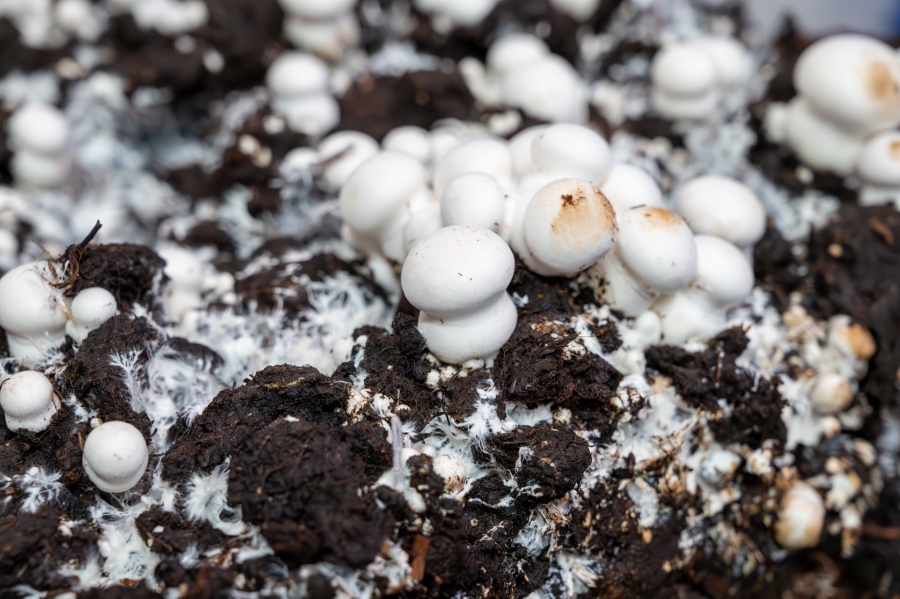
To induce A. bisporus fruit body formation, a casing layer is applied to the surface of the compost. Without a casing layer, few if any mushrooms will form. Several theories have been proposed over the years to explain why a casing is needed to initiate the fruiting of mushrooms. I will attempt to cover most of the theories, but will not mention the scientists or researchers who proposed them. If the reader is interested in that information, please contact the author.
A variety of materials have been used for casing. Topsoil, clay peat, spent compost substrate, crushed brick, coal ash, rock wool, pelletized recycled paper products, fly ash, coconut hulls, and various combinations of peat-sand, peat-soil, and peat-vermiculite. It is rather difficult to draw a common property from all these materials, which may serve as a trigger for the mechanism to induce mushroom formation. Several theories have been presented to explain the function of the casing layer and the initiation of the fruiting mechanism.
1. Moisture and Pressure relationships: It has been suggested that a macro-climate in the mushroom house and a micro-climate at the bed surface exist, which will create conditions of slow but continuous evaporation without desiccation of the compost. This special water gradient between the compost, casing, and air is claimed to be necessary for the formation of mushrooms. However, this idea is not supported by those who have grown in caves and in certain chambers where relative humidities are 100% and little to no evaporation occurs. Evaporation seems to play a more important role in pin development. The pressure theory suggests that mechanical pressure exerted by the casing on the mycelium initiates the fruiting process. However, this theory does not seem reasonable, where, under conditions of poor ventilation, little or no fruiting occurs, yet the pressure from the casing still exists.
2. Kleb’s or Klebsian theory: This theory suggests that the tendency for fructification in the casing (soil) is caused by the soil being largely devoid of nutrients yet favorable in its external conditions, such as temperature, moisture, and aeration, for the growth of mushrooms. In other words, reproduction in lower organisms, such as fungi, occurs when characteristic external conditions become unfavorable for growth. Exhaustion of the food supply favors reproduction. As the mycelium grows from the nutrient-rich compost into the casing layer, which is nutritionally poor, fructification is stimulated. This theory was tested by drying and grinding compost to a fine dust. The dried compost was rewetted and used as casing on the same compost after a complete spawn run. Normal mushrooms and a good yield were obtained. Similar experiments were performed, and, in all cases, normal yields were achieved. Therefore, it has been shown that this theory of a change in external low-nutrient conditions cannot be applied to the commercial mushroom, A. bisporus.
3. Fruiting Hormone: These theories propose that a substance, possibly volatile in nature, is produced by the mushroom mycelium, which acts as a hormone that stimulates fruiting. In this scenario, the casing layer acts to either increase or decrease the concentration of the “hormone,” ensuring the proper concentration of the substance is reached and maintained to initiate fructification.
One mechanism that was proposed suggested that some volatile substance emitted from the mycelium in the compost and in the casing stimulates mycelial growth and inhibit fruiting. It was suggested that the function of the casing was to provide a medium for rapid oxidation-reduction reactions that would destroy this compound. However, when moist white-silica sand (an inert material) was used as casing material and placed in a high RH chamber to prevent drying, normal mushrooms were formed, and a good yield was achieved.
Other experiments were performed in closed-chamber experiments, which showed that mushrooms do not form unless the air circulated in the system was washed with soda lime, mineral oil, or alkaline KMnO4. A similar closed chamber setup, which recirculated the air while providing provisions for introducing oxygen into the system as needed, was used to demonstrate that when the same air is recirculated into the growing chamber, no mushrooms form. When air was circulated through charcoal, and then back into the chamber, normal production occurred. Air that was washed with soda lime to remove CO2 and possibly some short-chain organic compounds did not form mushrooms. Both researchers showed that a substance produced that is not removed will inhibit the fruiting of the mushrooms.
Another researcher suggested that a high-molecular-weight substance, hormone-like and highly volatile, is produced by the mycelium. The functions of any casing layer are to sufficiently inhibit the volatilization and/or diffusion of the material so that a certain concentration is obtained to provide the stimulus for fruiting in the mycelial network of the compost. This substance and/or other materials, if present in too high a concentration, inhibit fruiting by adversely affecting the rhizomorphs in the casing layer.
4. Carbon Dioxide (CO2): Experiments were conducted introducing various amounts of CO2 into a closed chamber. He found that concentrations above 0.5% caused an inhibition of fruiting. Using more precise monitoring and detection equipment, others found that CO2 concentrations as low as 0.1% had a detrimental effect on fruiting and that different mushroom strains responded differently to different concentrations. From these experiments, a theory was proposed that a partial pressure gradient of CO2 is necessary for fructification of the commercial mushroom. The casing layer is the region where the high CO2 connections meet the low concentration above it. For fructification to occur, they suggested that the level of CO2 above the casing must be less than 0.1% to 0.5%, but the strains used today will fruit at levels above that.
5. Stimulation by microflora theory: Another proposed theory on the initiation of fruiting is initiated by microorganisms. By inoculating fruiting mushroom initials on a petri dish with sterilized compost and casing, it was shown that no fruit body initials formed. However, using non-sterilized casing on the other half of the petri dish, fruiting occurred. It was concluded that a living organism was responsible for initiating fruiting. It was further postulated that these organisms were bacteria, and they lived in the casing. It was suggested that the bacteria were stimulated by volatile metabolites from the compost mycelium, which were oxidized or converted by the bacteria, thus initiating fruiting. Several bacteria have been isolated from the casing layer and proposed to be involved in the fruiting process. Pseudomonas putida has been isolated from the casing, and it was suggested that it was the growing mycelium that released volatiles into the environment of the casing, which allowed for the predominance of this bacterium.
However, several studies have shown that the addition of activated charcoal to the sterilized casing facilitates fruiting. It was suggested that charcoal adsorbs the volatile metabolites of the mushroom mycelium, which controls vegetative growth, thereby eliminating the barrier to fructification. These studies effectively disprove the theory that bacteria alone are essential for the fruiting of A. bisporus. However, bacteria may have an influence on the quantity of fruit bodies initiated during commercial mushroom production. The increase in vegetative mycelial growth and fewer pins in high-temperature pasteurized casing compared to non-pasteurized casing is circumstantial evidence supporting a role for bacteria.
At least six metabolic gases have been shown to be produced by the mycelium of A. bisporus: CO2, ethylene, acetaldehyde, acetone, ethyl alcohol, and ethyl acetate. Although others suggested that acetone was the most important gas, the fungistatic effects of ethylene on many soil-borne fungal pathogens are well known. Substantial levels of ethylene have been shown to be produced from the mycelium, not the fruit bodies, of A. bisporus as the pins were rapidly developing.
The association between lipid metabolism and fruiting in A. bisporus was discovered quite by accident while studying the supplementation of mushroom compost at casing time. While adding materials that would be economically available for growers, researchers discovered exceptional pinning yields when a meal they used contained oil with lipids. Further research has shown that materials containing lipids and oils improve pin initiation and mushroom yield.
Summary
It appears that no single mechanism is responsible for initiating the mushrooms' fruit bodies and determining the quantity of mushrooms that form and develop. Our best guess currently involves the role of microbes and the accumulation of one or more volatiles in the casing layer. Are the microbes producing these volatile compounds, or are they using them in their metabolism, thereby accumulating them in their cells? What is the role of lipids as a nutrient for the mushroom spawn growth, pin formation, and yield? It is known that mannitol plays a role in the osmotic potential gradient between the spawn in the compost and the mushrooms growing on the casing. But is that the only nutrient influencing pinning? Hopefully, someday, research technology will enable us to answer some of these questions and provide growers with more tools to control pin sets, resulting in optimum fresh quality and maximum yields.





